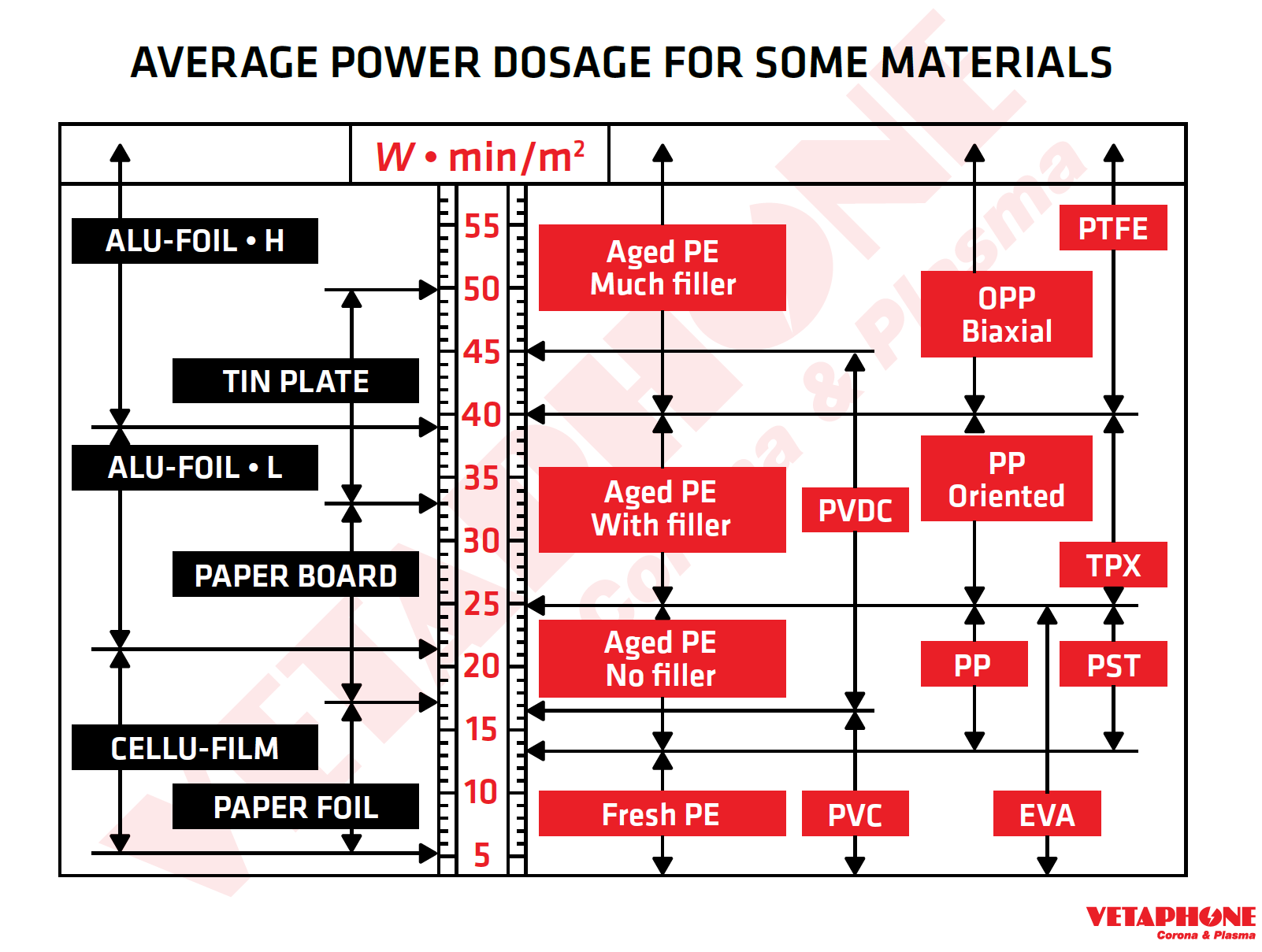
| Determining Correct Watt Density (Material Factor) | ||||
Prepared by: EH | Approved by:
| Valid from: 260504 | Document no.:
| Rev. no.
| |

Procedure:
1. Objective
To determine the specific Watt Density (W * min/m^2) required to achieve a target surface tension (Dyne level) for a specific substrate.
2. Pre-Test Setup
- Mode Selection: Ensure the Vetaphone generator is set to AUTOMATIC mode.
- Note: In "Manual/Power" mode, the system outputs a fixed Wattage. In Automatic mode, the system uses Watt Density, adjusting power dynamically as line speed changes.
- Target Identification: Define your required Dyne level (typically 40–56 Dyne, depending on your ink, coating, or adhesive requirements).
- Zero-Point Test: Test the untreated material with Dyne pens to establish the baseline surface energy.
3. The Testing Process
To find the Material Factor, follow these incremental steps:
- Initial Setting: Set the Watt Density on the display to 10 W * min/m^2.
- Run Sample: Run the material through the treater at a steady production speed.
- Dyne Test: Use the Dyne pens to check the treated surface.
- Evaluate: * If the Dyne level is below the target: Increase the Watt Density by 5-10 units (e.g., move to 15 W * min/m^2) and re-test.
- If the Dyne level is at the target: You have found your Material Factor.
- If the Dyne level is above the target: Decrease the Watt Density slightly to avoid over-treatment or material degradation.
- Validation: Once the target is reached, run a longer sample to ensure consistency across the web width.
4. Understanding Power Calculations
The system operates based on the following formula:
P = T x S x W x M
- P = Total Power (Watts)
- T = Number of sides to treat
- S = Line Speed (m/min)
- W = Treatment Width (m)
- M = Material Factor (Watt min/m^2)
5. Important Technical Note: Minimum Power Threshold
Users may notice the Watt Density value on the display increasing when the line speed is very low or idle. This is normal behavior.
The Vetaphone system requires a Minimum Power Setting (e.g., 300\ W) to "ignite" the electrodes and maintain a stable discharge. If your calculated power (S \times W \times M) falls below this minimum, the system will output the minimum 300\ W to stay ignited.
Example of the "Floor" Effect:
If you set 20 W/m^2 at a very slow speed (30 m/min):
- Calculated Power: 20-Watt Density x 30 M/Min x 0.34 M Electrode Width = 204 Watts.
- Since 204 W is below the 300 W ignition threshold (Min POWER), the system will output300 W.
- The display will update to show the actual applied treatment: 300W / (30 M/Min x 0.34 M) =29.4 W/m^2.
Pro Tip: To get the most accurate Material Factor during testing, ensure your line speed is high enough that the required wattage is well above the system's minimum power threshold.